
Reducing plastic waste generation and pollution in Guinea Bissau

“Plastic pollution may not yet be as visible in Guinea-Bissau as in larger economies, but the direction is clear. Population growth, urban expansion, and changing consumption patterns are increasing pressure on a waste system that is already stretched. Without early action, the problem will grow quickly over the next decade.
Walking through Bissau’s markets and along the port, you see how single-use plastics, mainly bottles and sachets are part of everyday commerce. At Safim landfill, open burning and informal waste picking bring into focus the wider consequences of unmanaged waste for health and livelihoods.
In 2024 alone, Guinea-Bissau generated approximately 30,400 tonnes of plastic waste, with more than half entering the environment each year. If nothing changes, over 260,000 tonnes could accumulate in land and waterways over the next decade.
Together with the Ministry of Environment and Climate Action and the International Union for Conservation of Nature, we co-developed Guinea-Bissau’s National Action Plan to Tackle Plastic Pollution. The Plan draws on national data, stakeholder consultations, and technical analysis to identify practical steps for reducing leakage.
The target is ambitious but achievable: a reduction of up to 79% in annual plastic pollution by 2035 — protecting Guinea-Bissau’s rivers and coasts, and preserving the ecological and cultural heritage of the Bijagós Archipelago.”
Faryal Gohar, Project Manager
Plastic pollution in Guinea Bissau
30,400 tonnes
of plastic waste generated in 2024 (0.038 kg per person per day)
56%
of plastic waste leaked into the land or water
260,000 tonnes +
could accumulate in the environment by 2035 without action
Strategies to reduce plastic pollution by 79% by 2035
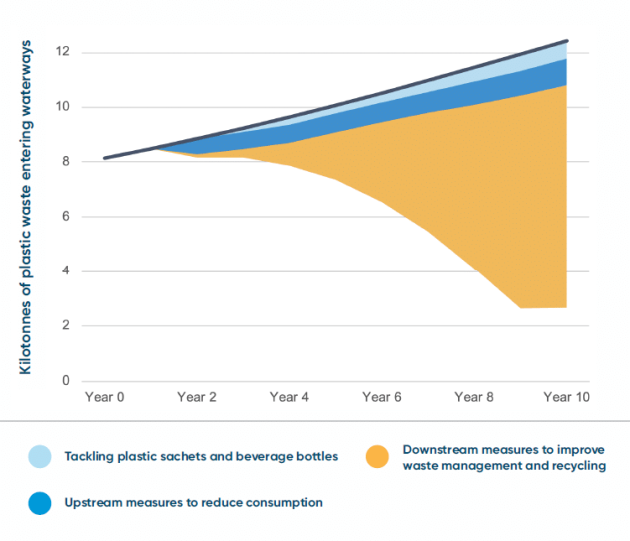
The National Action Plan sets out system-change strategies that could cut annual plastic pollution by 79% by 2035 — a reduction of around 9,750 tonnes per year compared to business as usual.
Strategy 1 – Item focus: Tackling plastic beverage bottles and sachets
Strategy 2 – Upstream measures to reduce consumption
Strategy 3 – Downstream measures to improve waste management and recycling
Our supporters
Supported by funding from the UK Government through UK International Development, Common Seas is partnering with five Small Island Developing States (SIDS) to develop National Action Plans to tackle plastic pollution.
As part of the Sustainable Blue Economies Programme, this critical funding is allowing us to develop and scale an approach tailored to the unique challenges and needs of SIDS, which are disproportionately affected by the plastic crisis. The project is supporting partner governments to radically reduce ocean plastic in their countries over the course of ten years and contribute to a sustainable blue economy.
Our partners

