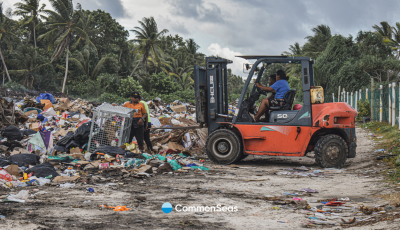
What happens when we design circular systems around the realities of islands from the outset, rather than trying to retrofit circularity into systems built for linear consumption? That was the key question we explored in our recent World Circular Economy Forum Accelerator Session: Unlocking circularity in Small Island States.
Across the globe, circular economy solutions are advancing at pace. Upstream solutions like Extended Producer Responsibility (EPR), Deposit Return Schemes (DRS) and reuse models all play crucial roles in reducing plastic pollution at source by keeping materials in circulation for longer, increasing recovery rates for recycling, and sustainably financing plastic waste management.
However, standard global frameworks often fail to address the unique local constraints that many Small Island Developing States face.
To address this challenge, we brought together experts for an Accelerator Session as part of the World Circular Economy Forum 2026. The online session explored insights from across the Pacific, Caribbean and Indian Ocean on how to design, finance and scale fit-for-purpose circular solutions that drive lasting reductions in plastic pollution in SIDS.
Beyond linear constraints: the operating context in Small Island Developing States
Small Island Developing States bear a disproportionate strain from plastic pollution. While SIDS contribute only a fraction of global plastic production, their geographic and economic realities make sustainable waste management a challenge. Limited land area means landfill space is rapidly depleting. Waste volumes are often small and fragmented, and transport costs are high, with end markets often located at great distances. This often means that incineration and landfill are the only options available.
On top of this, small islands face the mounting challenge of legacy plastics: marine plastic pollution that originates in international waters but washes up in increasing volumes on SIDS’ shores.
SIDS are among the most ambitious countries in the world when it comes to addressing the plastics crisis, but the challenges they face can present barriers to implementing effective interventions to reduce plastic pollution in practice. In short: scaling down standardised models for small islands is not a straightforward solution.
However, as our session explored, tailored solutions do exist.
From Extended Producer Responsibility to reuse: tailoring solutions for success in SIDS
Participants joined us from Barbados, Sri Lanka, Fiji, PNG, Tuvalu, Palau and many more countries around the world to hear our experts’ insights and share their own experiences of implementing projects to increase circularity in island contexts.
Our fantastic line-up of expert speakers included Camille Mondon (Ministry of Environment, Seychelles), Jonas Barkhau (GIZ), Andrea Cino (WRAP), Axel Darut (Circulearth), Dagny Tucker (Perpetual) and Alex White (Department of Environmental Management, Hawaiʻi).
Together in conversation with Carla Worth, our Head of Policy and moderator for the discussion, they shared insights highlighting how regional collaboration and harmonised approaches can overcome scale constraints, improve investment conditions and support delivery across dispersed markets.
Key insights at a glance:
- The challenges SIDS face make linear systems are very costly – both financially and environmentally.
- Solutions need to be designed around each island’s specific realities – always locally-owned and evidence-based.
- Regional collaboration and value chain engagement can help to overcome many of the structural constraints SIDS face.
- Islands’ constraints can become unique opportunities – creating cases for reducing imports, retaining materials locally, and developing circular systems.
- SIDS’ innovative solutions can be scaled across regions and other remote geographical archetypes.
The session made it clear that this isn’t just about helping SIDS catch up. Small Island States in fact have a unique opportunity to leapfrog some of the challenges associated with linear models that larger economies are now trying to retrofit solutions around.
Reframing the narrative: SIDS as circularity innovators
Despite facing additional barriers to implementing existing systems for circularity, SIDS have long been among the countries leading the way in calling for a just transition to a resilient blue economy.
Small Island Developing States made history during negotiations towards the Paris Agreement, leading calls for a 1.5°C target to limit global warming. Since UNEA Resolution 5/14 to deliver a legally-binding instrument to end plastic pollution was announced in 2022, they have demonstrated the same bold leadership in advocating for a sustainable circular economy.
In Plastics Treaty negotiations, SIDS have consistently been among the most ambitious countries, calling for bold upstream measures to cut plastic production, protections against the potential impacts of plastic on human health, and an equitable financial mechanism to support policy implementation – including for the remediation of legacy plastic waste.
On the national level, their leadership continues – despite resource constraints.
Earlier this year, Guinea-Bissau, Grenada, Papua New Guinea, Saint Lucia and Tuvalu completed the development of ambitious national policy roadmaps and reports to reduce waste generation and prevent plastic from leaking into the environment. Co-developed by Common Seas and government partners, these ambitious plans could reduce plastic pollution in each country by up to 79% over the coming decade.
Since then, they have taken significant steps towards turning these plans into action. Just last month, Guinea-Bissau’s National Action Plan to Tackle Plastic Pollution was officially approved by the Council of Ministers. This triggered immediate cross-government directives to tackle high-impact items including single-use plastic bags and water sachets.
Why SIDS are leading the way
Clearly, constraints are not holding SIDS back from pursuing systemic change. In fact, SIDS have a particularly strong business case for prioritising circular systems.
Linear models are exceptionally costly for islands – both financially and environmentally. At the same time, SIDS’ small size and closed-system characteristics present unique opportunities to drive upstream reduction, curb unnecessary imports, retain materials within local reuse systems, and design out waste at source.
As Carla reflected, “The main message I’m taking away is SIDS don’t necessarily need to catch up with circularity models developed elsewhere. They have an opportunity to design systems differently from the outset — around resource constraints, resilience, prevention and the realities of island economies.”
These innovation opportunities also offer broader lessons for larger economies currently that often struggle to retrofit circular principles into legacy systems built for linear consumption. By demonstrating how regional harmonisation, locally-owned policies, and upstream prevention can operate cohesively across dispersed markets, SIDS are charting a blueprint for countries with similar challenges to follow.
Throughout our Accelerator Session, the consensus was clear: SIDS should not be viewed as vulnerable nations unable to keep pace with larger economies, but instead as some of our greatest advocates for ambition today, and as potential future leaders in circular systems design.
How we support Small Island States to innovate circular solutions
No one policy alone can deliver the scale of change required to safeguard a healthy environment and a resilient blue economy for Small Island States. As we heard from our panellists, many solutions already exist – but the challenge can’t be solved from one perspective alone.
Our analyses with country partners consistently show that the most impactful approach is a suite of upstream and downstream policies working together, using tailored, collaborative approaches to overcome common challenges.
At Common Seas, we tailor solutions and mechanisms with a proven record of reducing plastic pollution at scale to the special circumstances of island nations. We drive regional and global cooperation to amplify SIDS’ needs and work with partners to drive knowledge sharing and accelerate the replication of good practices across markets.
For example, in 2025 we collaborated with Circulearth and a group of expert organisations to develop research into how a regional approach to EPR could help to overcome scale constraints, improve investment conditions and support delivery across dispersed markets.
The resulting Vision Paper – endorsed by 40 global organisations including Nestlé, WWF and several SIDS government departments – demonstrated that regional EPR could provide one sustainable solution to the financing and logistics of waste management challenges in remote island geographies.
This research led to a partnership with the Indian Ocean Commission to explore implementation with its members states, as well as strong interest to begin implementing a regional approach in the Caribbean.
Working alongside governments, regional bodies, local stakeholders and the private sector, our work continues to adapt solutions such as EPR, reuse and DRS to the specific context of SIDS and remote geographies.
What’s next?
Keen to dive deeper into circularity in SIDS? You can find additional reflections and insights on the event page.
If you are interested in collaborating with us to explore innovative solutions to plastic pollution in SIDS, we would love to hear from you. Email us at [email protected] to connect with the team.
Find out more

WCEF Accelerator Session: Unlocking circularity in Small Island States
Our online accelerator session at WCEF2026 will explore how regional collaboration can help overcome plastic pollution challenges in SIDS.
Read more
Regional EPR in SIDS and Remote Geographies
New research led by Common Seas and Circulearth explores how a regional approach to Extended Producer Responsibility (EPR) could help to tackle plastic pollution in SIDS and remote geographies.
Read more